
Well-Being isn’t extra, it’s infrastructure.
Well-being at UW Medicine means creating organizational conditions that enable individuals and teams to do hard, meaningful work with trust, connection, safety, and support. It protects health, maintains our humanity, and makes caring for each other and those we serve sustainable.
UW Medicine’s 2026-2030 Well-Being Strategic Plan outlines a system-wide commitment to fostering well-being across our diverse working and learning communities.
| Our Goal The goal of this plan is to provide direction for well-being efforts across the system by aligning them with our six strategic priorities. In addition, we aim to advance system-level well-being initiatives. The plan outlines the six strategic priorities and our initial system-level goals and tactics for each priority. |
Taking a Collaborative Approach
The plan was guided by data from the UW Medicine Well-Being Survey and extensive engagement of our well-being committees and numerous faculty, staff, and trainees.
In 2022, we piloted a Well-Being Survey to better understand the needs of our faculty physicians, advanced practice providers, and trainees. We replicated this survey system-wide in 2024 for all of UW Medicine, with plans to survey well-being theme changes over time. The data provide an understanding of what is impacting well-being outcomes for each unit. It also provides insights into the burnout and professional fulfilment of our teams in comparison to national averages for similar groups in other academic healthcare systems.
We also created well-being committees to help us hear the voices of our people and infuse a focus on well-being throughout UW Medicine. These include:
- Well-Being Steering Committee (leaders across UW Medicine)
- School of Medicine Department Lead Well-Being Committees (biomedical research and clinical department faculty and staff representatives)
- UW Medicine Council on Faculty Well-Being (faculty representatives across specialties and practice sites)
Additionally, we partnered with site-specific well-being groups such as Care4U at UWMC and the HMC Resiliency Committee. Collaboratively, these committees helped co-create our strategic plan and distilled the diverse well-being needs into six strategic priorities.
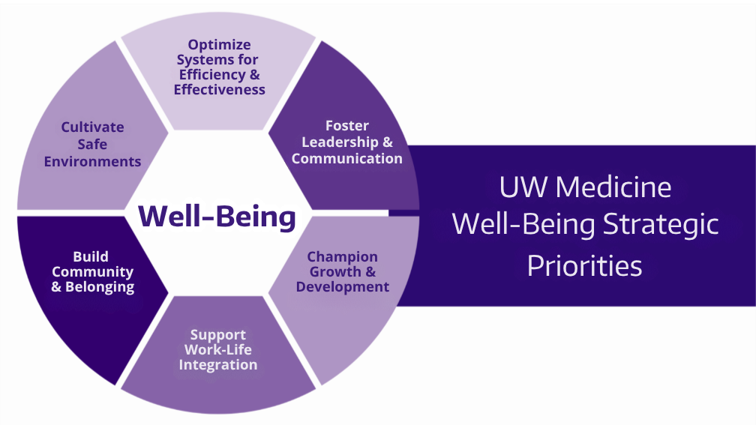
UW Medicine System-Level Strategic Priorities, Initial Goals, and Tactics
We will track progress toward our initial goals through supporting local-level prioritization and action planning and a system-level report.
1. Optimize systems to support more efficient and effective work
Initial Goal: Build systems to promote efficiency, support managing workload, and streamline administrative tasks
Tactics:
- Pilot clinical optimization programs like AMA’s GROSS intervention
- Clarify role expectations across sites and positions
- Implement ambient AI to reduce clinical administrative burden
- Expand support systems including training for staff, researchers, and trainees navigating external grant-based funding in an evolving research landscape
- Launch local team quiet weeks, where and when possible, to reduce meeting burden
Key Partners: Centralized Services, Innovation Core, IT, UW Medicine local and senior leadership, UW Medicine HR, and SoM HR
2. Foster collaborative leadership and transparent communication
Initial Goal: Develop communication and leadership skills among leaders across all organizational roles
Tactics:
- Close the loop on requests and feedback by supporting leadership responsiveness
- Support new training programs and role clarity for local-level leaders
- Prioritize systems of feedback that ensure safe consideration of employee feedback
- Partner with the UW Medicine Enterprise Learning Leaders and UW Medicine Organization Development and Training, Office of Research and Graduate Education, Office of Faculty Affairs, and Office of Healthcare Equity to provide training opportunities
- Continue offering UW Medicine leadership panel discussions on emergent topics to improve culture and engagement
- Centralize leadership communications via the Vitals intranet and other forms of regular, inclusive information sharing
Key Partners: UW Medicine Enterprise Learning, UW Medicine Organization Development and Training, Communications, Office of Research and Graduate Education, Office of Healthcare Equity, UW Medicine Leadership, and Office of Faculty Affairs
3. Champion professional development and growth
Initial Goal: Expand access to leadership and skill-building opportunities
Tactics:
- Coordinate with Office of Faculty Affairs, Office of Research and Graduate Education, UW Medicine Enterprise Learning and UW Medicine Organization Development and Training to provide professional development opportunities
- Promote accessible resources like LinkedIn Learning
- Support the creation and growth of local-level mentorship programs
Key Partners: Office of Healthcare Equity, Office of Faculty Affairs, UW Medicine Enterprise Learning and UW Medicine Organization Development and Training, and Departmental leaders
4. Support work-life integration and professional fulfillment
Initial Goal: Improve access to care and utilization of services, time off, and leave
Tactics:
- Increase access to healthcare appointments at UW Medicine for employees and families
- Enhance lactation support and integrate it into workflows
- Partner with Work/Life to improve childcare and housing services for employees.
- Develop sustainable time-off and leave practices for all employees and establish EPIC in-basket and service coverage guidelines
- Support and implement work identified by the Enterprise Learning team
Key Partners: Enterprise Learning, Mandatory Education, Work/Life, The Whole U, and IT
5. Cultivate safe environments where people thrive
Initial Goal: Promote psychological safety and innovative workplace violence reduction trainings across UW Medicine
Tactics:
- Support continuous improvement and implementation of best practices for mitigating workplace violence and develop aftercare systems
- Develop psychological safety training with OHCE, Research Mentor Education Program and CLIME for our varied work and learning environments
- Partner with OHCE on inter-provider professionalism and incivility resources
- Support education and training across our system to improve workplace violence prevention
Key Partners: Office of Healthcare Equity, Center for Learning in Innovation in Medical Education (CLIME), Graduate Medical Education, Office of Research and Graduate Education, UW Medicine Public Safety and Security Services, Alieu Ann in the role of Chief Security Officer, Health System leaders – including CMOs and CNOs, UW Police Department, and SafeCampus
6. Build connection, community, and belonging
Initial Goal: Strengthen system-wide identity and connection
Tactics:
- Expand peer support programs
- Continue providing well-being grants to teams across the system
- Collaborate with The Whole U to promote system-wide well-being
- Launch a Well-Being content campaign in partnership with the Vitals team
- Guide system-wide discussions about the limitations and benefits of remote, hybrid, and in-person work
Key Partners: Office of Healthcare Equity, Office of Faculty Affairs, Office of Research and Graduate Education, The Whole U, and Communications, Healthsystem leaders including CMOs and CNOs
2026-2027 Core system-level areas of focus for each strategic priority:
- Optimize systems to support more efficient and effective work
- The Pebbles Project – pilots at UWMC-NW and HMC in autumn
- Foster collaborative leadership and transparent communication
- Leadership: Expanding workshop content for well-being skills development
- Communication: Vitals utilization
- Champion professional development and growth
- Well-Being Grants
- Plan and expand development opportunities for all
- Support work-life integration and professional fulfillment
- Benefit optimization (includes vacation, employee access to medical appointments, mental health supports, etc.)
- Cultivate safe environments where people thrive
- Suicide awareness, prevention and postvention
- Physical safety in all work environments
- Build connection, community, and belonging
- Well-Being Grants
Alignment
Our strategic priorities connect back to and help us move the dial on the UW Medicine mission, the School of Medicine strategic plan, and our University of Washington strategic plan.